
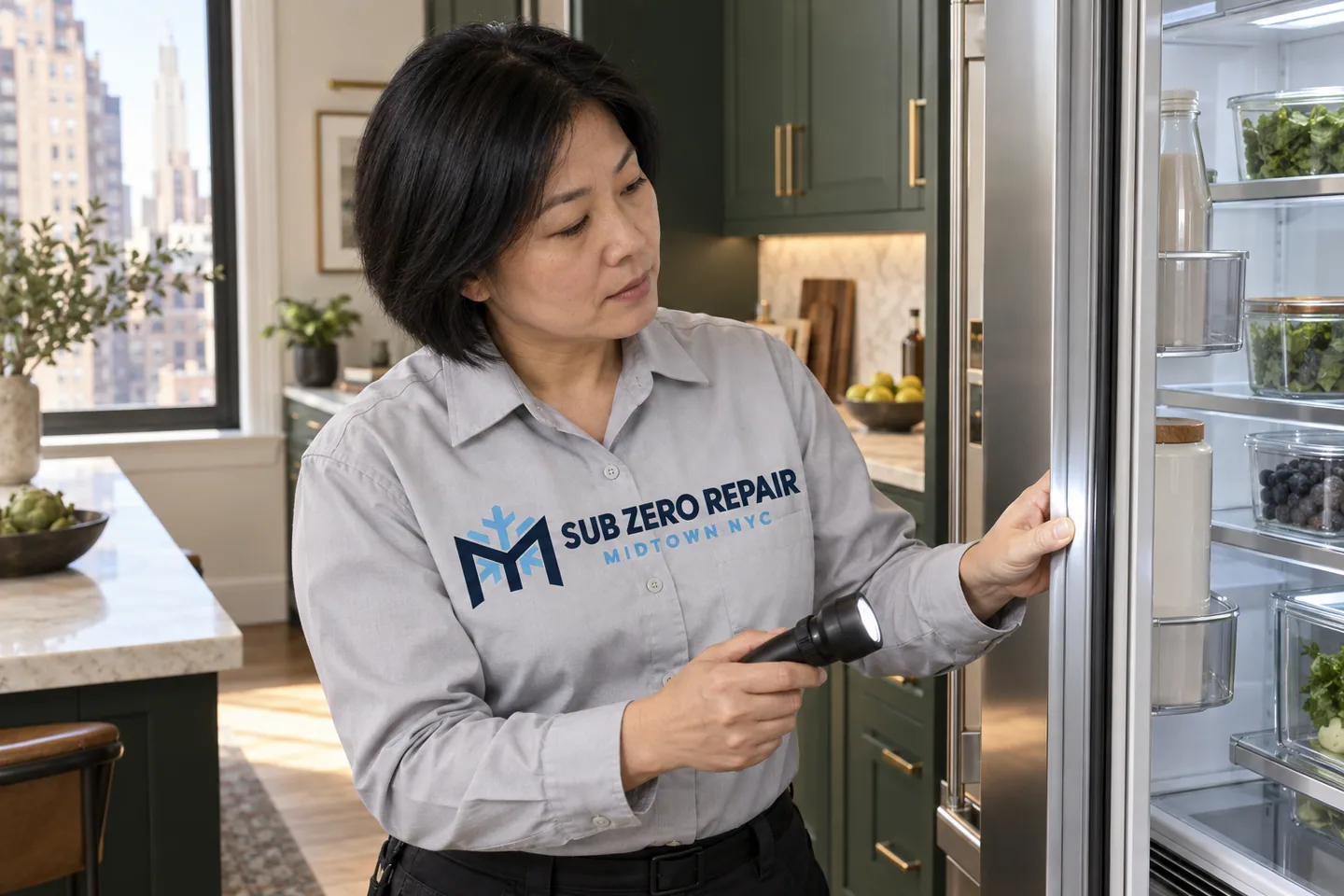
Describe closure in ordinary use
Say whether a loose item blocks the opening, the door rubs or it appears to close normally. Remove only a simple loose obstruction. Do not adjust a heavy panel or hinge to test whether cooling improves.
Record any alert and distinguish the fresh-food compartment from the freezer. A custom finish can conceal independent columns; identify the refrigerator itself where possible.
Explain recent work without assigning a cause
New panels, cabinet adjustment or a move of the appliance belong in the history. Include the timing and any earlier service record. A condition beginning after work is useful context, but its cause still needs assessment.
Do not pull the refrigerator from the enclosure to look behind it. Explain the available clearance and keep permanent components in place.
Discuss the visit and immediate storage needs
Arrange suitable alternative storage for temperature-sensitive contents if refrigeration is unreliable. Call 212-540-2172 to review the Sutton Place address, building requirements and diagnostic charge. A repair recommendation follows evaluation of the actual unit.
A FEW HELPFUL ANSWERS
Before your service visit
Does a rubbing panel prove that it caused the temperature problem?
No. Report both observations so their relationship can be assessed rather than assumed.
Is a photograph of the finished kitchen enough to identify the model?
It may help describe access, but a safely accessible appliance label or original documentation is more dependable for identification.